NEWS
What got us here won’t get us there: assessing management teams in private equity
November 23, 2026
Every investment committee memo has a section on management. Too often it reads like a reference check: strong track record, deep sector knowledge, founder still highly committed. All true, and all about the past.
A private equity investor needs to ask something different. Can this team, as it is set up today, take this business to that exit? We often find the answer is “not without some changes”. The firms that create the most value find that out early and act on it quickly.
Most barriers to growth are internal
When we look at portfolio companies that have stalled, the cause is rarely the market. It is usually something inside the business:
- Organisational complexity. Bureaucracy creeps in as the company grows, and decisions slow down.
- Culture. Risk-averse habits, slow processes and a leadership team that has drifted away from the front line.
- Lack of focus. Shifting priorities, no shared vision, and change fatigue from one initiative after another.
- A soft or ever-changing business model. No clear view of core capabilities, and one major transformation after another.
- People practices. Incentives, performance management and succession planning that no longer match what the business needs.
Every one of these comes back to leadership. So assessing the management team is more than a box to tick at due diligence. It is the best single predictor of whether the value creation plan will be delivered.
Look for the symptoms, not just the CVs
A team can look excellent on paper and still be the thing holding growth back. The warning signs we see most often:
- A founder or team that is not scaling with the business
- Revenue growing faster than the talent base
- New hires who don’t fit the culture of the top team
- Only a small share of employees emotionally connected to the company
- The innovative spirit of the early years fading
- Slower decision making, less accountability in the line, and more silos and politics
- Leaders with no real skin in the game
None of these show up in a management presentation. You find them by talking to the people who report to the top team, watching how decisions really get made, and asking how long it takes to get something approved.
Assess across the whole deal cycle, not just at entry
Leadership is usually assessed at the investment stage, and the best investors make any needed changes quickly. But the questions change as the hold period goes on.
Origination and due diligence.
Assess the individuals and the team as a unit. Work back from what the business will need in future, and look honestly at the culture. The core question: does the top team have the right mix of capabilities and experience to scale?
The first 100 days.
Start from the exit and work back to the capabilities needed to get there. Be clear about the leadership required and where the gaps are, then start hiring. Executives new to PE often benefit from coaching on what ownership, pace and accountability mean when a sponsor is involved.
Ownership.
Focus on how well the team works together, how cohesive it is and how fast it decides. Look at the dynamics between the leadership team and the board. Is the pace of decision making where it should be? Do senior leaders have the emotional intelligence and resilience the plan demands? Does the team rally people around the mission?
Pre-Exit.
Revisit capabilities again: forming a newboard, streamlining the organisation, and aligning exit incentives.
Build backwards from exit
Most management assessments start with the team in the room and ask whether they are any good. We think it works better the other way round. Start with the business you plan to sell, and ask what leadership capabilities a buyer or public market investors will expect to see at exit. Then work backwards to today.
Working back from exit gives you:
- A capability map, not a list of names. The roles, skills and experience the business will need at each stage of the hold period.
- An honest gap analysis. Which gaps current leaders can close with development, and which need new hires.
- Timing. When each capability has to be in place, so hires are made before they are needed rather than after a missed plan.
- Succession and incentives that point the same way. Critical roles are defined early, and rewards are tied to building the business a buyer will pay for.
The point is to look past the talent you have today and build the team the exit will need.
Five questions every deal team should answer
- Does the team have the right mix of capabilities and experience to scale, and not just to run what exists today?
- Is decision making fast enough? Where do decisions stall, and who is the bottleneck?
- Do the senior leaders have the EQ and resilience to lead through a demanding value creation plan?
- Does the team rally people around a clear mission and build a high-performing culture?
- Do incentives create real ownership? Leaders should own outcomes, not just manage processes.
Structured tools help here. Psychometric profiling, for example, can get the board and management to agree on the core people attributes needed to scale. It can also make difficult conversations more objective.
Leadership doesn’t sit alone
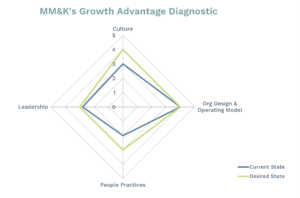
A strong leadership team in a cluttered organisation will still struggle. We see leadership as one of four connected drivers of what we call the Growth Advantage. The other three are a scalable culture, a focused organisation design and operating model, and deliberate people practices.
That last driver matters. In PE we often hear that what got us here will not get us there. Yet many companies keep the incentive schemes, performance management and succession plans they had when they were a fraction of the size. When you assess the team, also assess the systems the team has built around itself.
Act early, keep it pragmatic
Fixing leadership gaps does not need a large-scale transformation. A quick diagnostic and a few deliberate moves usually do more than a multi-year programme:
– Activate leadership. Build a bias to action and an aversion to bureaucracy. Upgrade underperforming leaders, build a cohesive top team and define clear leadership behaviours.
– Focus on the critical few. Pick three to five priorities, put resources behind them, and stop or deprioritise everything else.
– Build an ownership mindset. Push decision-making authority down and hold leaders accountable for outcomes.
– Shape the people practices that drive scale. Succession plans that build capability, and rewards that give people skin in the game without complexity.
The best time to have these conversations is before the deal closes. The second-best time is now.
MM&K is a leading independent adviser to PE firms and their portfolio companies on the design and implementation of human capital solutions and tailored pay structures. If you are curious and want to explore how MM&K could assist your Board to optimise the advantages of aligning pay, strategy and culture, contact Rob Miller (robert.miller@mm-k.com) or Stuart James (stuart.james@mm-k.com).
Registered Address: 6th Floor, Kings House, 9/10 Haymarket, London, SW1Y 4BP | Company Registration No: 1983794 | VAT Registration No: 577735784
Copyright 2026 © MM&K. All Rights Reserved | Site by: Treacle